


Master SAFe Training and Certification
Welcome to the guide on SAFe training and certification! This document provides a comprehensive summary of SAFe. It also explains the importance of SAFe. Additionally, it shows how you can receive training and certification in SAFe.
SAFe (Scaled Agile Framework) is a popular methodology organizations use to scale agile practices across their entire enterprise. Created in 2011 by Dean Leffingwell, many organizations use it to effectively manage large-scale agile projects.
This guide explains the basics of SAFe, certification levels, and how to become an expert through training and certification.
What is SAFe?
SAFe is a framework designed to help organizations implement agile practices at scale. It follows Lean and Agile principles and helps scale Agile across many teams, departments, and organizations.
SAFe incorporates different levels of planning, coordination, and collaboration between teams to ensure that everyone is aligned toward achieving the same goals. It also emphasizes continuous improvement through feedback loops and regular retrospectives.
The goal of SAFe is to enable organizations to deliver value faster, better, and with higher quality by leveraging agile practices at a larger scale.


WHY YOU NEED SAFe TRAINING AND CERTIFICATION
Investing in SAFe training and certification is crucial for individuals and organizations adopting the Scaled Agile Framework.
The Rising Demand for SAFe and Certificate

1. Gain a comprehensive understanding of SAFe
SAFe is a complex framework that consists of various roles, practices, and principles. Without proper training and certification, it can be challenging to fully understand and implement SAFe effectively. SAFe training provides a comprehensive overview of the framework, including its core principles, values, and practices. It also covers the roles and responsibilities of each team member in an organization practicing SAFe.
By learning SAFe, people understand how all parts of it work together to help organizations be more flexible. This understanding is crucial for organizations looking to successfully implement SAFe and reap its benefits.
2. Enhance your skills and knowledge
SAFe certification is not just a piece of paper; it represents an individual's proficiency in the framework. SAFe certification exams are rigorous and require individuals to demonstrate their knowledge and skills in various aspects of SAFe.
Studying for and passing the certification test can improve people's knowledge of SAFe. It can also help them understand how to use SAFe in real-life situations.
SAFe training teaches practical skills for everyday work. These skills include creating Agile Release Trains, organizing PI Planning events, and using Lean-Agile practices. These skills make people more valuable to their organizations and aid personal and professional growth.
3. Stay up-to-date with the latest developments
SAFe is continuously evolving to meet the ever-changing needs of businesses. By undergoing SAFe training and certification, individuals can stay updated with the latest developments in the framework. This makes sure that organizations use the latest SAFe version, helping them get the best outcomes.
Furthermore, individuals with SAFe certifications are required to renew their certification every year by completing a certain number of continuing education hours.
This helps individuals stay current with new features and updates in SAFe and ensures that they maintain their proficiency in the framework.
4. Showcase your commitment to Agile principles
SAFe builds upon the core Agile values and principles, such as collaboration, continuous improvement, and customer focus. By investing in SAFe training and certification, individuals demonstrate their commitment to these principles and their desire to improve themselves and their organizations continuously.
Certification shows someone's commitment and effort in learning SAFe and how to use it effectively. This can be especially beneficial for individuals looking to advance their careers in Agile organizations.
5. Gain recognition and credibility
As SAFe becomes more widely adopted by organizations, the demand for certified professionals is also increasing.
Getting SAFe certification boosts credibility at work and in job market, making individuals recognized as framework experts.
Organizations also benefit from having certified professionals on their team as it demonstrates their commitment to implementing SAFe effectively. This can attract potential clients and partners, leading to business growth and success.
Why is SAFe important?
Many businesses have adopted agile methodologies to quickly adapt to changing market conditions due to digital transformation. However, as companies grow in size and complexity, implementing agile practices across the entire organization becomes challenging.
SAFe helps organizations address this challenge by providing a structured framework for scaling agile practices. It also promotes cross-team collaboration, alignment, and continuous improvement, crucial for successful agile implementation at scale.
SAFe is widely used for big agile projects and trusted by many companies as a dependable framework for handling complicated projects. PMI Training and Certification
SAFe Training and Certification
There are various levels of SAFe training and certification that professionals can pursue, depending on their career goals and experience. These include:
1. SAFe Agilist (SA)
This is the most basic level of SAFe certification, designed for Scrum Masters, Product Owners, or Agile Team Members looking to gain a fundamental understanding of Agile principles and practices.
2. SAFe Practitioner (SP)
This certification is best suited for professionals who are working in agile teams or are responsible for implementing agile practices at the team level.
3. SAFe Product Owner/Product Manager (POPM):
This certification is ideal for individuals who want to gain a deeper understanding of the roles and responsibilities of a product owner or product manager in a SAFe organization.
4. SAFe Scrum Master (SSM)
This certification is for Scrum Masters looking to enhance their knowledge and skills in the context of a SAFe organization.
5. SAFe Advanced Scrum Master (SASM)
This certification is for experienced Scrum Masters who are looking to take on leadership roles in a SAFe environment.
6. SAFe Release Train Engineer (RTE)
This certification is designed for individuals responsible for facilitating and managing Agile Release Trains within a SAFe organization.
7. SAFe DevOps (SDP)
This certification is for professionals looking to understand the principles and practices of DevOps in a SAFe environment.
8. SAFe Lean Portfolio Management (LPM)
This certification is for individuals looking to gain an understanding of the roles and responsibilities of a Lean Portfolio Manager in a SAFe organization.
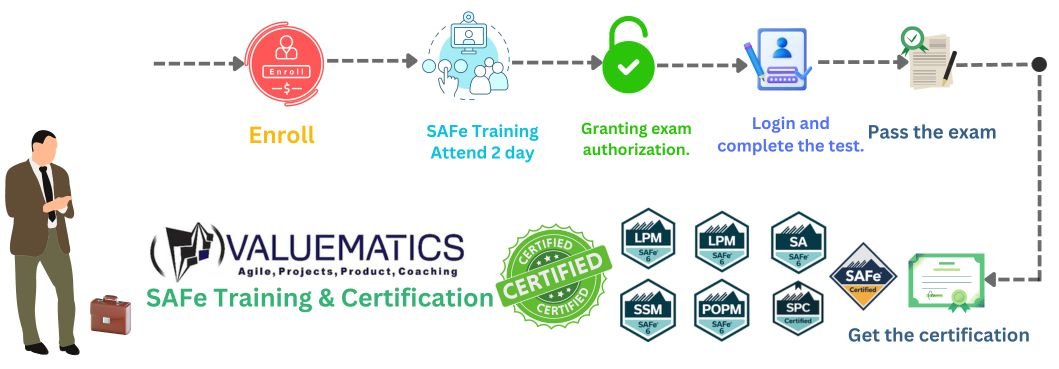
PROCESS TO GET A SAFe TRAINING AND CERTIFICATION
Benefits of SAFe Training and Certification
SAFe (Scaled Agile Framework) training and certification offers professionals a comprehensive understanding and practical knowledge of scaling agile methodologies. The benefits of becoming SAFe certified are numerous, including but not limited to the following:
1. Improved Career Opportunities
As more organizations adopt agile methodologies, the demand for SAFe-certified professionals is on the rise. This opens up a whole new range of career opportunities for individuals who have completed SAFe training and certification.
2. Enhanced Knowledge and Skills
SAFe training and certification equip professionals with the knowledge and skills to successfully implement agile practices at scale. This includes understanding lean thinking, Agile Release Trains, DevOps, and other key concepts that are essential for scaling agile.
3. Increased Marketability:
SAFe certification is recognized globally and is highly valued by organizations looking to adopt agile practices. Holding a SAFe certification makes professionals more marketable and competitive in the job market.
4. Better Team Collaboration
SAFe training and certification teach individuals how to effectively collaborate with cross-functional teams, leading to improved communication, productivity, and overall team performance.
5. Improved Project Success Rates
With a better understanding of scaling agile methodologies, SAFe-certified professionals can effectively lead large-scale projects and increase the chances of project success.
6. Networking Opportunities
SAFe training and certification programs offer professionals the opportunity to network with other like-minded individuals. This can lead to new business connections, career opportunities, and the exchange of ideas and best practices.
7. Continuous Learning
SAFe training and certification is not a one-time event. Professionals are required to renew their certification every year, which encourages continuous learning and staying up-to-date with the latest industry trends and best practices.
How to Get Trained and Certified in SAFe
There are two ways to get trained and certified in SAFe: self-study or attend a class. Self-study is an option for those who have prior knowledge and experience with agile methodologies, while attending a class is recommended for those new to SAFe.
SAFe offers both online courses and in-person classes, which can be found on their website. These courses cover the fundamentals of SAFe, its principles, practices, and roles.
After completing the course, you will need to take an exam to become certified. The exam can be taken online or in-person at a testing center. Upon passing the exam, you will receive your certification from SAFe and become part of a global community of SAFe professionals.
TRANSFORM YOUR WORKFORCE WITH THE SKILLS OF THE FUTURE
The SAFe Scrum Master Certification is a valuable credential for professionals seeking to excel in the Agile Scrum framework within a SAFe environment. The certification ensures that you have the skills and understanding to provide effective facilitation, leadership, and coaching in a Scrum team.
Furthermore, this certification validates your ability to successfully plan and execute the Program Increment, a significant element in aligning teams to a common mission toward delivering value.
Acquiring the SAFe Scrum Master certification can facilitate your contribution in transforming your workforce into a future-ready, high-performing team.
In today's dynamic business landscape, organizations are constantly evolving to meet the changing demands of customers. As such, having a workforce equipped with the skills of the future is vital for businesses to stay competitive and thrive in the market. These skills include adaptability, agility, critical thinking, and collaboration – all of which are fostered through the SAFe Scrum Master certification.
Conclusion
In summary, SAFe is a valuable framework for organizations looking to implement agile practices at scale. Getting trained and certified in SAFe can help you become an expert in this methodology and open up new career opportunities.
Remember to continuously learn and improve your skills by attending workshops, conferences, and networking with other SAFe professionals. With the right knowledge and experience, you can become an asset to any organisation implementing SAFe. So, don't hesitate to start your journey towards becoming a certified SAFe professional today!


A SAFe Agilist (SA) strategically guides the adoption, success, and ongoing improvement of Lean-Agile culture in an enterprise. The Agilist helps define the organizational mission and vision, and communicates strategic decisions and the need for change to all stakeholders and teams. The SAFe Agilists motivate knowledge workers by helping them develop their skills and careers in a way that enhances their capabilities and increases their engagement and commitment to the mission and vision of the enterprise.
During this two-day course, they’ll learn the principles and practices of the Scaled Agile Framework®, how to execute and release value through Agile Release Trains, and what it means to lead a Lean-Agile transformation at enterprise scale.
Attendees will gain an understanding of the Lean-Agile mindset and why it’s so effective in today’s adapt-or-die marketplace. They’ll also get practical advice on supporting Agile teams and programs, empowering a Lean Portfolio, building a continuous delivery pipeline and DevOps culture, and coordinating large solutions.
Key features
Price of the course includes:
Delivery of two-day Leading SAFe training course conducted live online by a experienced trainer certified by Scaled Agile, Inc., provider of SAFe®
Preparation and eligibility to take the SAFe®65 Agilist (SA) certification exam (SAFe 6 Agilist Exam)
Modern online training platform
Attendee workbook licensed by Scaled Agile, Inc. (PDF)
One year membership to the SAFe Community Platform, with access to members-only resources such as webinars, workbooks, guidance presentations, and advance notice of upcoming SAFe products
One Certification exam attempt upon General Availability of the course
Course certificate of completion
SAFe® 5 Agilist certification upon passing of exam
Prerequisites:
All are welcome to attend the course, regardless of experience. However, the following prerequisites are highly recommended for those who intend to take the SAFe® 6 Agilist (SA) certification exam:
5+ years’ experience in software development, testing, business analysis, product, or project management
Experience in Scrum
Working methods:
Multimedia presentations, group exercises and discussion, practical workshops, case study and online practice tests.
Licensing of the SAFe® training course:
Leading SAFe training course offered by Advised Skills Ltd is provided under Scaled Agile, Inc. Partner Program Agreement and complies with the requirements for Scaled Agile, Inc. Courseware License Agreement.
Advised Skills Ltd is a Partner of Scaled Agile, Inc..
Who should attend?
The following individuals will benefit from this course:
Executives and Leaders, Managers, Directors, CIOs, and VPs
Development, QA, and Infrastructure Management
Program and Project Managers
Product and Product Line Management
Portfolio Managers, PMO, and Process Leads
Enterprise, System, and Solution Architects
Course Agenda
Learning Goals:
To perform the role of a SAFe Agilist, attendees should be able to:
Apply SAFe to scale Lean and Agile development in the enterprise
Recognize and apply a Lean-Agile Mindset and principles
Continuously explore, integrate, deploy, and release value
Empower with a Lean Portfolio
Coordinate the development of large solutions
Enhance their Lean-Agile leadership skills
Support a Lean-Agile transformation in their enterprise
Exam Details
Name: SAFe® 6 Agilist Exam
Format: Multiple Choice
Delivery: Web-based (single-browser), closed book, no outside assistance, timed
Access: Candidates can access the exam within the SAFe Community Platform upon completion of the Leading SAFe course
Duration: Once the exam begins, candidates have 90 minutes (1.5 hours) to complete the exam
Number of Questions: 45
Passing Score: 35 out of 45 (77% passing score)
Exam language – English
Exam cost: First exam attempt is included as part of the course registration fee if the exam is taken within 30 days of course completion. Each retake attempt costs 50 USD
Retake policy: Second attempt on exam (first retake) can be done immediately after first attempt. Third attempt requires a 10-day wait. Fourth attempt requires a 30-day wait
Professional Development Units
Professional Development Units (PDUs) and Scrum Education Units (SEUs)
Attendees may be eligible to apply for 15 PDUs toward their continuing education requirements with the Project Management Institute (PMI) for PMP, PgMP, and PMI-ACP certifications.
Course Identifier: ABOYTD2
Attendees may be eligible to apply for SEUs under Category C, toward earning or renewing their CSP through Scrum Alliance.


Build your skills as a high-performing team member of an Agile Release Train (ART)—and prepare to support the facilitation of team and program events— when you become a SAFe® 6 Scrum Master (SSM).
In this two-day certification workshop, you’ll gain an understanding of the role of Scrum Master in a SAFe® enterprise. Unlike traditional Scrum Master training that focuses on the fundamentals of team-level Scrum, the SAFe® Scrum Master course explores the role of the Scrum Master in the context of the entire enterprise, and prepares you to successfully plan and execute the Planning Interval (PI), the primary enabler of alignment throughout all levels of a SAFe® organization.
Audience
Intended for people new to the role of Scrum Master, or people wanting to better understand the role and how it fits in a SAFe® enterprise, attendees typically include:
New or existing Scrum Masters
Team Leads
Release Train Engineers.
Topics Covered
Introducing Scrum in SAFe®
Characterizing the role of the Scrum Master
Experiencing Program Increment planning
Facilitating Iteration execution
Finishing the Program Increment
Coaching the Agile team.
Learning Objectives
To perform the role of a SAFe® Scrum Master, you should be able to:
Describe Scrum in a SAFe® enterprise
Facilitate Scrum events
Facilitate effective Iteration execution
Support effective Program Increment execution
Support relentless improvement
Coach Agile teams for maximum business results
Support DevOps implementation.
Prerequisites
All are welcome to attend the certification workshop, regardless of experience. However, the following prerequisites are highly recommended for those who intend to take the SAFe® 6 Scrum Master (SSM) certification exam:
Familiarity with Agile concepts and principles
Awareness of Scrum, Kanban, and Extreme Programming (XP)
Working knowledge of software and hardware development processes.
Professional Development Units (PDUs) and Scrum Education Units (SEUs)
Professional Development Units (PDUs)
Attendees may be eligible to apply for 15 PDUs toward their continuing education requirements with the Project Management Institute (PMI) for PMP®, PgMP®, and PMI-ACP® certifications.
Scrum Education Units (SEUs)
Attendees may be eligible to apply for SEUs under category C, toward earning or renewing their CSP through Scrum Alliance.
What you get
Becoming a certified SAFe ® 5 Scrum Master requires an exceptional range of skills and is a career path for many Scrum Masters. Certification includes:
SAFe Scrum Master certificate
A SAFe 5 Scrum Master digital badge to promote your accomplishment online
A one-year certified membership as a SAFe Scrum Master, which includes access to the SSM Community of Practice
A SAFe Scrum Master certification usage guide with SSM certification marks
Access to Meetup groups and events that connect you with other SAFe certified professionals
A variety of learning resources to support you during your SAFe journey
Learn more about the benefits of SAFe community membership.

During this two-day course, attendees of SAFe Product Owner/Product Manager will gain an in-depth understanding of the Agile Release Train (ART), how it delivers value, and what they can do to effectively perform their role.
They will also learn how to apply Lean thinking to write Epics, break them down into Features and Stories, plan and execute Iterations, and plan Program Increments. Finally, attendees learn about the Continuous Delivery Pipeline and DevOps culture, how to effectively integrate as Product Owners and Product Managers, and what it takes to relentlessly improve the ART.
Attending the class prepares individuals to take the exam and become a certified SAFe® 5 Product Owner/Product Manager (POPM).
Key features
Price of the course includes:
Delivery of two-day SAFe Product Owner/Product Manager training course conducted live online by a experienced trainer certified by Scaled Agile, Inc., provider of SAFe®
Preparation and eligibility to take the SAFe® 5 Product Owner/Product Manager (POPM) certification exam (SAFe® 5 Product Owner/Product Manager Exam)
Modern online training platform
Attendee workbook licensed by Scaled Agile, Inc. (PDF)
One year membership to the SAFe Community Platform, with access to members-only resources such as webinars, workbooks, guidance presentations, and advance notice of upcoming SAFe products
One Certification exam attempt upon General Availability of the course
Course certificate of completion
SAFe® 5 Product Owner/Product Manager certification upon passing of exam
Prerequisites:
All are welcome to attend the course, regardless of experience. However, the following prerequisites are highly recommended for those who intend to take the SAFe® 5 Product Owner/Product Manager (POPM) certification exam:
Attend a Leading SAFe course
Experience working in a SAFe environment
Experience with Lean, Agile, or other relevant certifications
Working methods:
Multimedia presentations, group exercises and discussion, practical workshops, case study and online practice tests.
Licensing of the SAFe® training course:
SAFe Product Owner/Product Manager training course offered by Advised Skills Ltd is provided under Scaled Agile, Inc. Partner Program Agreement and complies with the requirements for Scaled Agile, Inc. Courseware License Agreement.
Advised Skills Ltd is a Partner of Scaled Agile, Inc..
Who should attend?
Target group:
The following individuals will benefit from this course:
Product Managers
Product Line Managers
Product Owners
Business Owners
Business Analysts
Solution Managers
Portfolio Managers
Program Managers
PMO personnel
Process Leads
Enterprise Architects
Solution Architects
System Architects
Course Agenda
Learning Goals:
To perform the role of a SAFe Product Owner/Product Manager, attendees should be able to:
Apply SAFe in the Lean enterprise
Connect SAFe Lean-Agile principles and values to the PO/PM roles
Collaborate with Lean Portfolio Management
Explore continuous value with Program Increment Planning
Execute the Program Increment and deliver continuous value
Articulate the Product Owner and Product Manager roles
Create a role action plan
Certification exam
A certified SAFe® Certified Product Owner/Product Manager (POPM) is a SAFe professional who works with customers and development organizations to identify and write requirements.
Attending the class prepares you to take the exam and become a SAFe® 5 Product Owner/Product Manager (POPM).
Exam requirements:
The first step toward becoming a SAFe Certified Professional is to attend the SAFe Product Owner/Product Manager course. This is a requirement, because attending the course provides access to all the study materials and the exam. Note that attending the course does not guarantee passing the exam.
More detailed information about SAFe examination you can find at Scaled Agile website.
Exam Details
Exam name: SAFe® 5 Product Owner/Product Manager Exam
Exam format: Multiple choice , multiple response
Exam delivery: Web-based (single-browser), closed book, no outside assistance, timed
Exam access: Candidates can access to the exam within the SAFe Community Platform upon completion of your SAFe 5 Product Owner/Product Manager course.
Exam duration: Once the exam begins, candidates have 90 minutes (1.5 hours) to complete the exam.
Number of questions: 45
Passing score – 33 out of 45 (73%)
Language – English
Exam cost – First exam attempt is included as part of the course registration fee if the exam is taken within 30 days of course completion. Each retake attempt costs $50.
Retake policy – Second attempt on exam (first retake) can be done immediately after first attempt. Third attempt requires a 10-day wait. Fourth attempt requires a 30-day wait.
What you get
Becoming a SAFe 5 Product Owner/Product Manager requires an exceptional range of skills and is a career path for many servant leaders. Certification includes:
SAFe 5 Product Owner/Product Manager certificate
A SAFe 5 Product Owner/Product Manager digital badge to promote your accomplishment online
A one-year certified membership as a SAFe Product Owner/Product Manager, which includes access to the POPM Community of Practice
A SAFe 5 Product Owner/Product Manager certification usage guide with POPM certification marks
Access to Meetup groups and events that connect you with other SAFe certified professionals
A variety of learning resources to support you during your SAFe journey
Learn more about the benefits of SAFe community membership.
Professional Development Units
Professional Development Units (PDUs) and Scrum Education Units (SEUs)
Attendees may be eligible to apply for 20 PDUs toward their continuing education requirements with the Project Management Institute (PMI) for PMP, PgMP, and PMI-ACP certifications.
Attendees may be eligible to apply for SEUs under Category C, toward earning or renewing their CSP through the Scrum Alliance.

A Certified SAFe® 6 Lean Portfolio Manager is a SAFe professional who works with enterprise executives, Product and Solution Managers, Enterprise Architects, Agile PMO personnel and Agile teams to align strategy and execution by applying Lean and systems thinking approaches to strategy and investment funding, agile portfolio operations, and governance.
Participants in the course have the opportunity to capture the current and the future state of their portfolio with the Portfolio Canvas tool and identify important business initiatives for achieving the future state. Participants also explore methods to establish portfolio flow with the Portfolio Kanban and prioritize initiatives for maximum economic benefit. The course also provides insights on how to establish Value Stream Budgets and Lean Budget Guardrails and measure the Lean portfolio performance.
Attending the class prepares individuals to take the exam and become a certified SAFe® Lean Portfolio Manager (LPM).
Key features
Price of the course includes:
Delivery of two-day Lean Portfolio Management training course conducted live online by a experienced trainer certified by Scaled Agile, Inc., provider of SAFe®
Preparation and eligibility to take the SAFe® Lean Portfolio Manager (LPM) certification exam (SAFe® 5 Lean Portfolio Manager Exam)
Modern online training platform
Attendee workbook licensed by Scaled Agile, Inc. (PDF)
One year membership to the SAFe Community Platform, with access to members-only resources such as webinars, workbooks, guidance presentations, and advance notice of upcoming SAFe products
One Certification exam attempt upon General Availability of the course
Course certificate of completion
SAFe® Lean Portfolio Manager certification upon passing of exam
Prerequisites:
All are welcome to attend the course, regardless of experience. However, the following prerequisites are highly recommended:
Familiarity with Agile concepts and principles
Attended Leading SAFe or SAFe PM/PO course
Experience working in a SAFe environment
Working methods:
Multimedia presentations, group exercises and discussion, practical workshops, case study and online practice tests.
Licensing of the SAFe® training course:
Lean Portfolio Management training course offered by Advised Skills Ltd is provided under Scaled Agile, Inc. Partner Program Agreement and complies with the requirements for Scaled Agile, Inc. Courseware License Agreement.
Advised Skills Ltd is a Partner of Scaled Agile, Inc..
Who should attend?
The following individuals will benefit from this course:
Executives and leaders (CIOs, CEOs, CFOs, CTOs, and Vps)
Enterprise Architects
Project, Program or Portfolio Managers
Solution Managers
Business unit managers
Program office personnel
Enterprise Agile coaches
SAFe Program Consultants
Human resources
Epic Owners
Release Train Engineers
Consultants
Directors
Course agenda
Learning Goals:
To perform the role of a Lean Portfolio Manager attendees should be able to:
Describe Lean Portfolio Management (LPM)
Connect the portfolio to enterprise strategy
Establish the Portfolio Vision
Implement Lean Budgeting and Guardrails
Establish flow with the Portfolio Kanban
Support operational excellence with an Agile Program Management Office (PMO) and Communities of Practice (CoPs)
Coordinate Value Streams
Measure LPM performance
Build a plan for LPM implementation
Certification exam
Completion of this course gives you access to the exam and all related study materials as part of your Learning Plan in the SAFe Community Platform.
A Certified SAFe® Lean Portfolio Manager (LPM) understands how Strategy and Investment funding is established, how to apply Agile Portfolio operations and Lean governance, and how to build a plan for implementing the Lean Portfolio Management function.
Attending the class prepares you to take the exam and become a SAFe® Lean Portfolio Manager (LPM).
Exam requirements:
The first step toward becoming a Certified SAFe® Lean Portfolio Manager is to attend the Lean Portfolio Management course. This is a requirement, because attending the course provides access to all the study materials and the exam. Note that attending the course does not guarantee passing the exam.
Exam prerequisite skills or knowledge:
Basic to intermediate understanding of SAFe
Basic understanding of strategy
Basic understanding of funding models
Understanding how to organize value streams
Attendees must attend the two days of the course in order to be eligible for the exam.
More detailed information about SAFe examination you can find at Scaled Agile website.
Exam Details
Exam name: SAFe® 5 Lean Portfolio Manager Exam
Exam format: Multiple choice; Multiple select
Exam delivery: Web-based (single-browser), closed book, no outside assistance, timed
Exam access: Candidates can access the exam within the SAFe Community Platform upon completion of the Lean Portfolio Management course
Exam duration: Once the exam begins, candidates have 120 minutes (2.0 hours) to complete the exam
Number of Questions: 60
Passing Score: 32 out of 45 (71% passing score)
Exam language – English
Exam cost: First exam attempt is included as part of the course registration fee if the exam is taken within 30 days of course completion. Each retake attempt costs 50 USD
Retake policy: Second attempt on exam (first retake) can be done immediately after first attempt. Third attempt requires a 10-day wait. Fourth attempt requires a 30-day wait. Contact support@scaledagile.com for any retake questions.
Professional Development Units
Professional Development Units (PDUs) and Scrum Education Units (SEUs)
Attendees may be eligible to apply for 30 PDUs toward their continuing education requirements with the Project Management Institute (PMI) for PMP, PgMP, and PMI-ACP certifications
Attendees may be eligible to apply for SEUs under Category C, toward earning or renewing their CSP through Scrum Alliance.
“Continuous Coaching Method”, which includes weekly coaching calls, on-demand one and one sessions, and continuous support until you pass the exam.